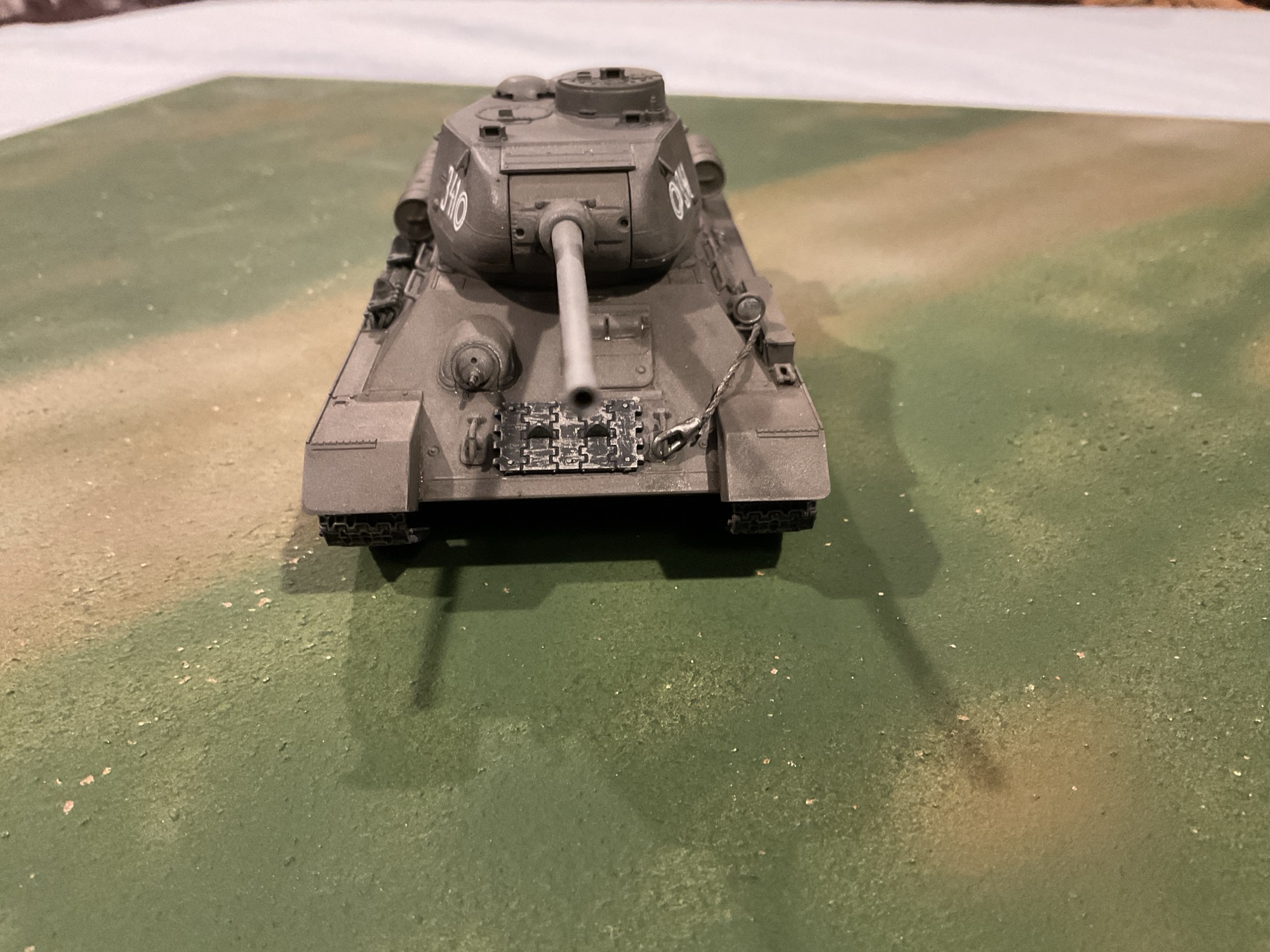
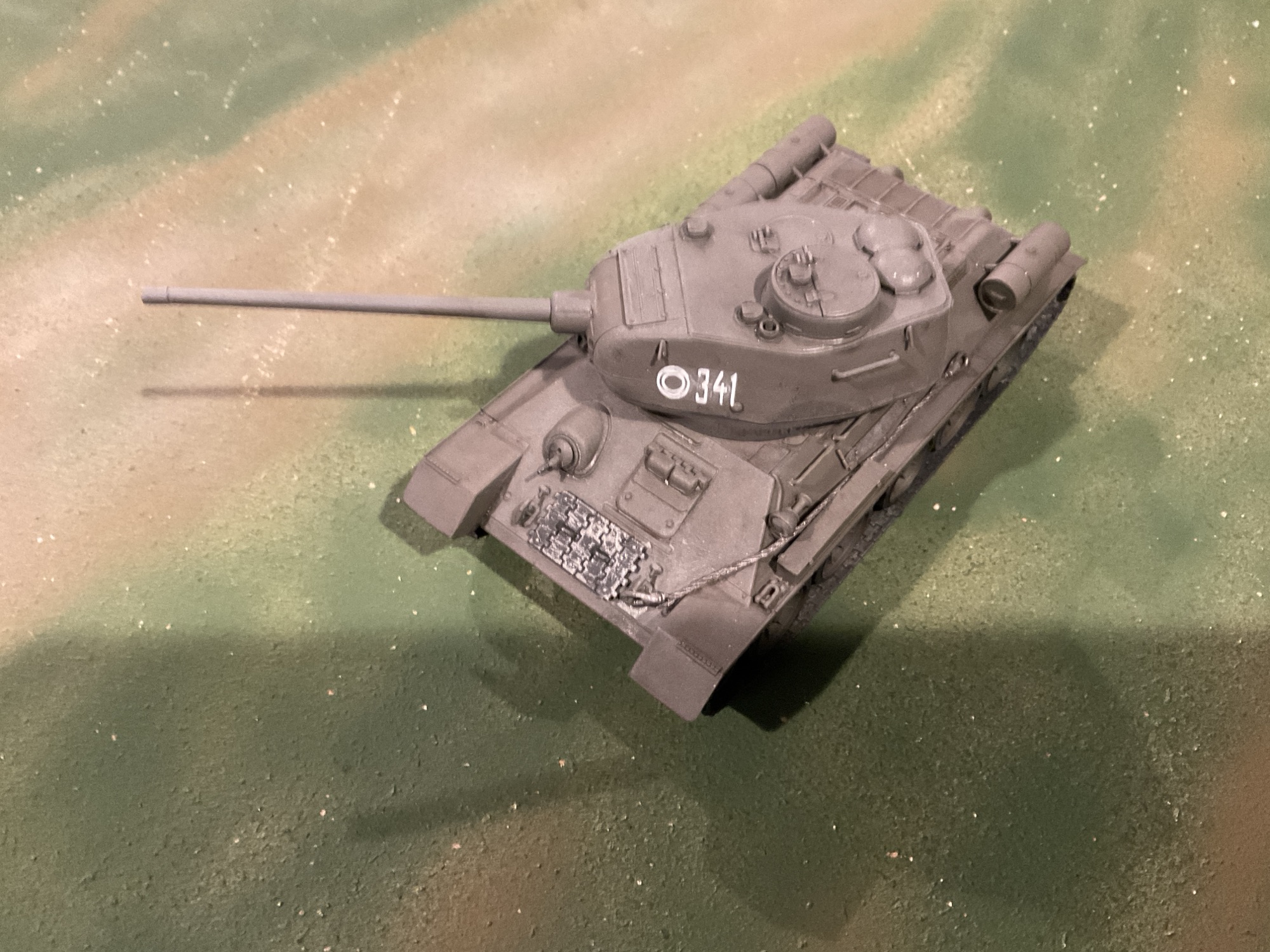
The main production version of the well known T-34 tank in the last two years of the War.

Let’s take a quick look at key medium tank.
We’ve mentioned a few times here the massive escalation in size and capability of armored fighting vehicles during the Second World War. Especially in the East. A lot of that really kicked into high gear because of the T-34.

In June of 1941, when Nazi Germany attacked the Soviet Union, they were shocked by the quality of a lot of Soviet Armor. Especially the heavy KV-1 tank and the fast medium T-34. The T-34 especially had well designed slopping armor that made it difficult for most current anti-tank guns to penetrate. The biggest German tank at this time was the Panzer IV F1, which carried a 50 mm anti-tank gun. This was not adequate. An improved 50 mm gun was planned for the F2 version of the Panzer IV, but as of June, the Wehrmacht knew this to be obsolete before it even entered production. The turret was redesigned around a 75 mm anti-tank gun. More to the point, a new, bigger Panzer was needed and this led directly to the Panther.
It also led to a profusion of cobbled together AFVs. A number of 75 or 76 mm anti-tank guns, many of them captured from the Reich’s many opponents, were the minimum acceptable. Germany’s own 88 mm gun was even better. Older AFVs were rebuilt, often with turrets removed and bigger guns mounted in the opening. The Marder line of Tank Destroyers were the best known of these types.

The T-34, which had caused this shock, had a fairly lengthy gestation. It was first conceived in 1934 (which is where the “T-34” designation came from). At the time, the Soviets were using a combination of slow moving and heavy “Infantry Tanks” and lighter, faster “Cavalry Tanks” (like many armies of the time). The T-34 was an attempt to simplify, to build one tank for both roles. It used a suspension system by American Engineer Walter Christie (also used in British Cavalry Tanks of the time) that was meant for both speed and low ground pressure.
Soviet experience in the undeclared border war with Japan (in Mongolia, 1938/39) led to final refinements before production started. It saw some test use in the Winter War against Finland (1939/40), and was entering mass production when the Germans entered Russia.
The T-34 was always a curious mix of sophisticated and crude. Perhaps like much Soviet design. The strengths are well noted; the tank was fast, generally reliable, had a good gun and very well designed protection.
But there were serious shortcomings too. US Army testing of the type was unimpressive. It was not water-tight, which led to electrical shorts and ammunition failure from any fording or even a light rain. The metals were incompatible alloys, which would accelerate aging/wear. The armor in particular was hard, but brittle; so it could often offer protection against only a single hit. Perhaps worst of all, the two man turret was wildly inefficient. It made internal communication difficult, gun loading was inefficient and slow, and visibility was poor. The two man turret was so tight the US Army marveled that two men in winter coats could even fit inside.
The German response to the initial T-34 was effective. Even more problematic for the Soviets would be the next generation of German armor. The Panther and Tiger tanks were more than capable against the T-34.

But the Soviets were not idle. The T-34’s biggest needs could be addressed in a single important upgrade. A new three man turret with a turret basket and bigger gun were needed. The original turret needed to be enlarged so three men; a commander, a gunner and a loader; could all function and communicate without getting in each others’ way.
Further, as German armor was getting better, a bigger gun was needed. This was obvious early on, that very first German response, the new variant of Panzer IV had gone to 80 mm of frontal armor.
A whole new Soviet tank was proposed, but the War emergency made that impractical. So a new turret which had been planned for a new tank was shoehorned onto the T-34. This included all the needed improvements in one upgrade.
In 1943, the new model was mixed into service with the existing T-34/76 models. Initially known as the “T-34, 1943 model”, it added an 85 mm anti-tank gun to the three man turret crew. The new gun led to it being reclassified as the T-34-85 in January 1944. This quickly became the only production model.
In total, over 90000 T-34s of all sub-types were built. Over 45000 of those were destroyed in WWII. Post-War they were widely exported, especially in the Soviet Bloc. It saw service in Korea and Vietnam, up to 100 may still be in military service.

This particular tank served with the 7th Guards Tank Corps in the 3rd Guards Tank Army; Battle of Berlin 1945.
This is the Tamiya kit. Funny story, Tamiya released the T-34/76 20 years ago (?). I was sure they had done a T-34-85 at about the same time, and I had bought one. I have many model kits boxed up, some I’ve certainly not seen in years. But I was sure I had a T-34-85, somewhere. Imagine my confusion a couple years ago when they advertised “coming soon, a T-34-85”. Huh. I did some searching on line, and I guess I remembered all wrong. So of course I bought one, and now I have proof that I have one!


 Plane Dave