
Lockheed’s big Lightning first came to prominence late in the North Africa campaign.

Let’s look at a primary operator of the type.
Early in World War II the 1st Fighter Group was charged with air defense of the West Coast flying a mix of P-38 Lightnings and P-43 Lancers. The group was training and building up for an eventual combat deployment, while also providing cadre officers and pilots for the many other fighter groups building up at this time. Many pilots came and went through the group until a final roster was arrived at for an April 1942 deployment to England. This involved the famous long range ferry flights through Greenland and Iceland. One group of six P-38s were forced down on Greenland, one of these was recovered 50 years later and today flies at airshows as “Glacier Girl”. One squadron, the 24th, was left in Iceland through August to provide air defense. On August 14, 2nd Lt Elza Shahan scored the first USAAF victory over the Luftwaffe (A Fw 200) while serving on that Iceland detachment.
In England they were assigned to the Eighth Air Force and participated in some of the earliest missions.
The first prolonged and grinding test for the US Army Air Force against the Luftwaffe was in North Africa and the Mediterranean from late 1942 through 1943. Appropriately the 1st Fighter Group was a participant in that campaign. They made the flight from England to Algeria and began operations there by November 13. This proved to be a brutally tough environment, starting with the extreme heat and sand that rapidly wore out engines. Then add in fighting the Luftwaffe.
At this point, in November, the new 12th Air Force had five Lightning Squadrons; the three of the 1st Fighter Group and two of the 14th (one squadron was permanently left in Iceland). They quickly scored kills against German transports and Stukas, but took heavy looses from the Bf 109s of JG 77. German fighter pilots quickly came to consider P-38s to be easy prey. The plane itself had some good qualities; high top speed, extremely fast climb, more maneuverable in most aspects (than a Bf 109) and heavy firepower. But inexperienced American pilots and poor tactics cost them heavily. The next two months put a heavy burden on the supply of P-38s, they were being destroyed faster than they were being built. Only the most optimistic of measures gave the P-38 anything better than a 1:1 kill ratio at this point.
Circumstances improved some in late December with the arrival of the 82nd Fighter Group. This was a more thoroughly trained new fighter group, and specifically trained in the P-38. Meanwhile, the 14th Fighter Group was withdrawn in January for an extended rest and refit. The 14th FG was so badly battered it was nearly disbanded entirely; but instead they received newer P-38Gs, many new pilots, and finally a third squadron.

American pilots never seemed to loose faith in the Lightning, even though to the end of the War German pilots considered it the Allied fighter they most wanted to face in combat. Over the last couple months of the North Africa campaign the 1st and 82nd Fighter Groups did finally start to show a positive kill ratio. This was greatly aided by the large scale effort by the Luftwaffe to keep Africa supplied by air. Many new aces were made against the Ju 52 and Me 323 Gigant. Supposedly the Germans started to call the P-38 “der Gabelschwanze Teufel” (the Fork Tailed Devil) in early 1943 as it exacted a toll against German transports and support types. My guess would be that this is nonsense, a product of allied propaganda. Certainly German fighter pilots never held the type in very high regard. Although it is possible it had a fearsome reputation among non-fighter pilots, it certainly deserved that.

The Summer of 1943 was a much slower period of operations. The 1st Fighter Group did fly some close support missions over Sicily from their base in Tunisia. In October they moved to Sardinia for a couple months and the pace of operations increased with the Italian Campaign. By the end of 1943 37 pilots had made Ace in the P-38. In December the 1st moved to Italy and was reassigned to the 15th Air Force (as were the 14th and 82nd Fighter Groups) as part of the new southern strategic bombing campaign. The 15th was about a third of the size of the 8th Air Force, but flew much the same sort of missions. The 1st, 14th and 82nd Fighter Groups remained in Italy flying P-38s to the end of the War.
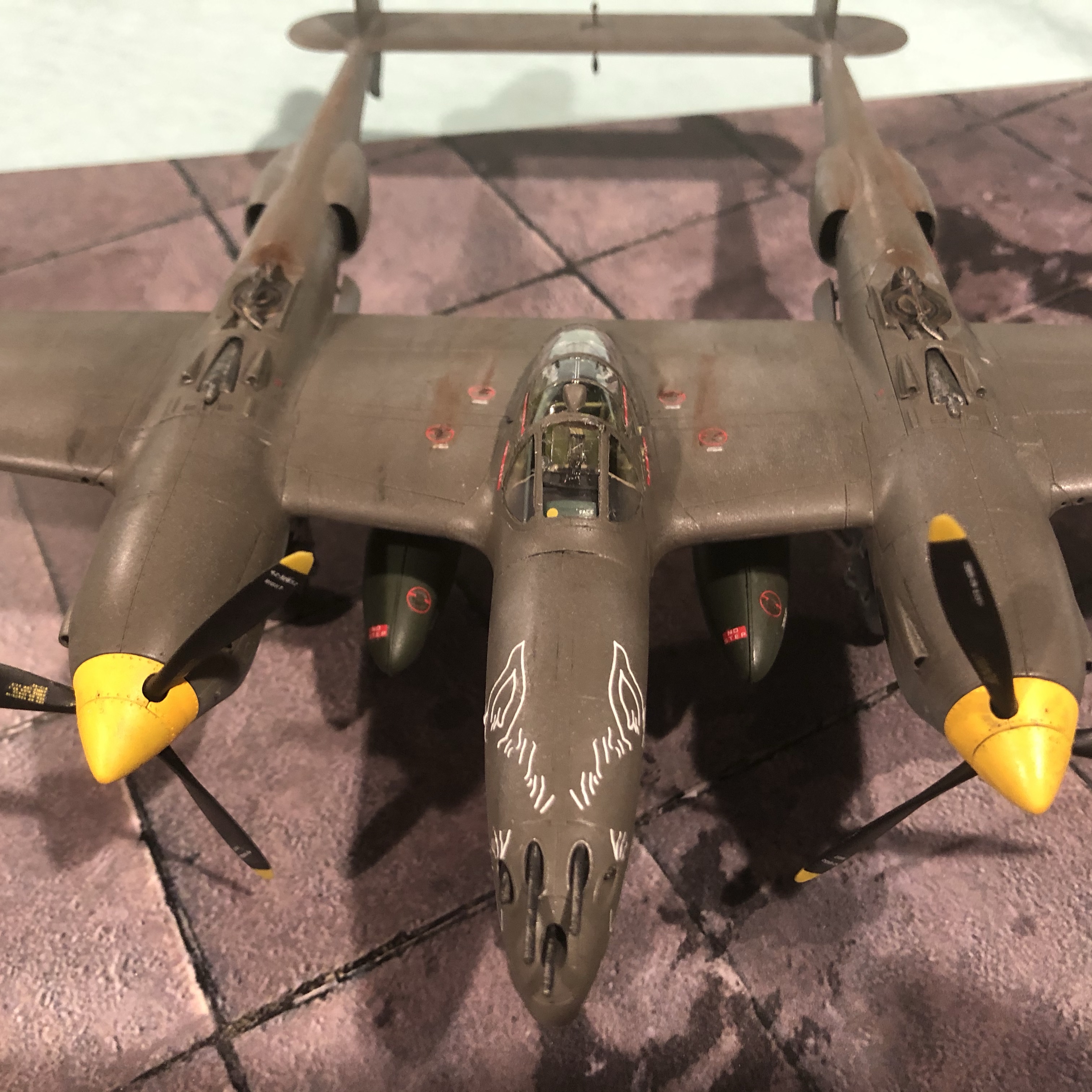

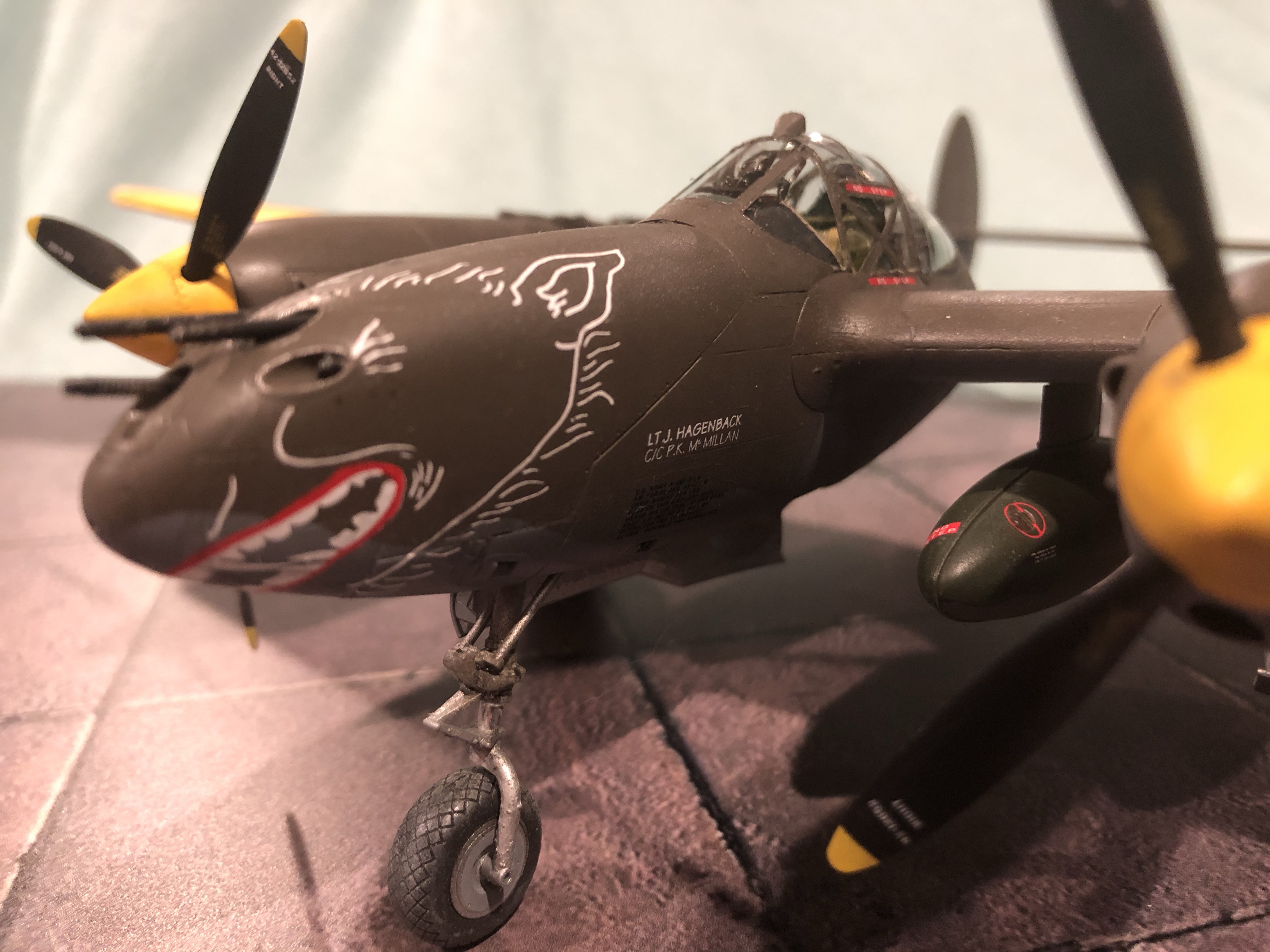
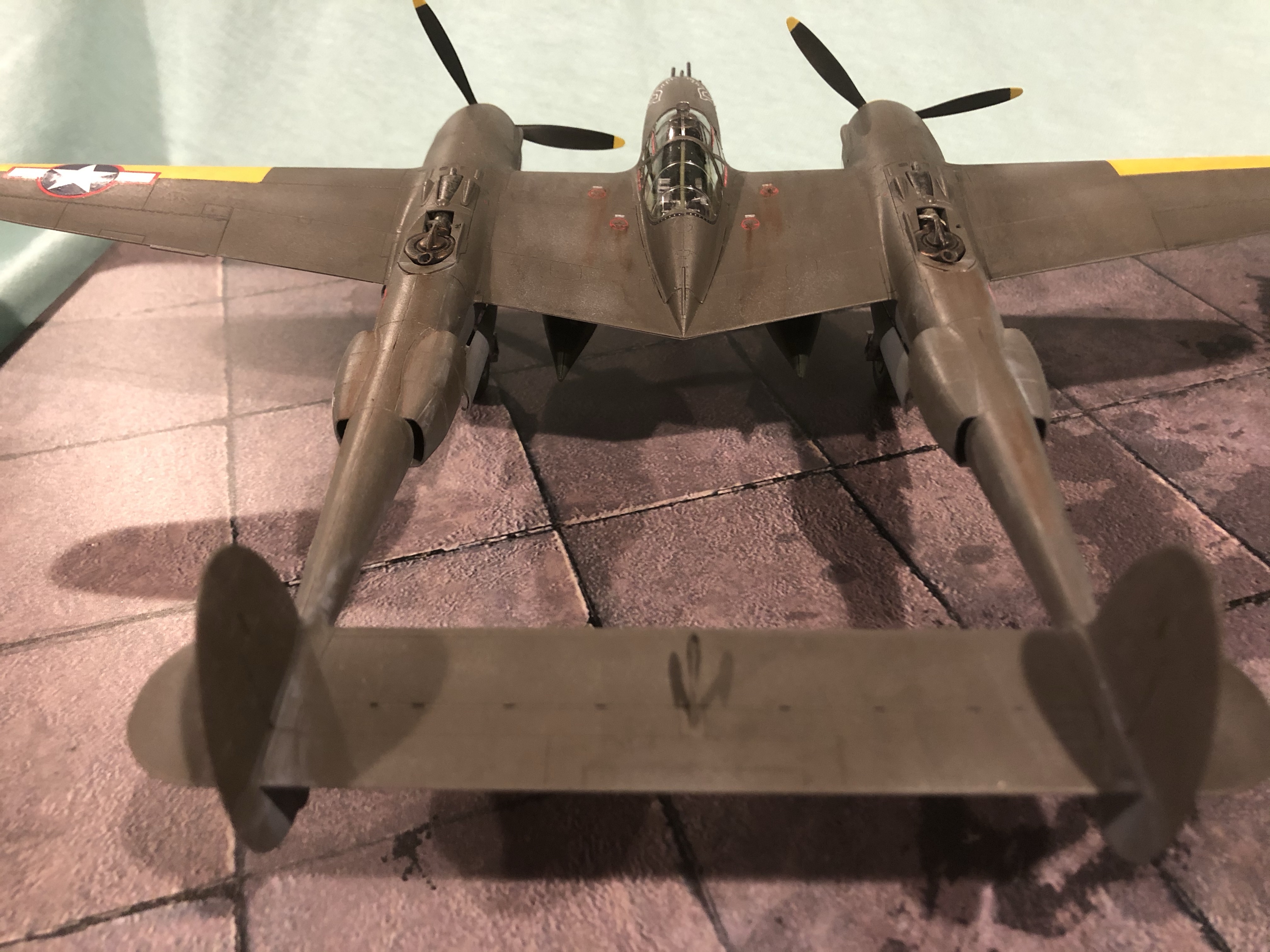
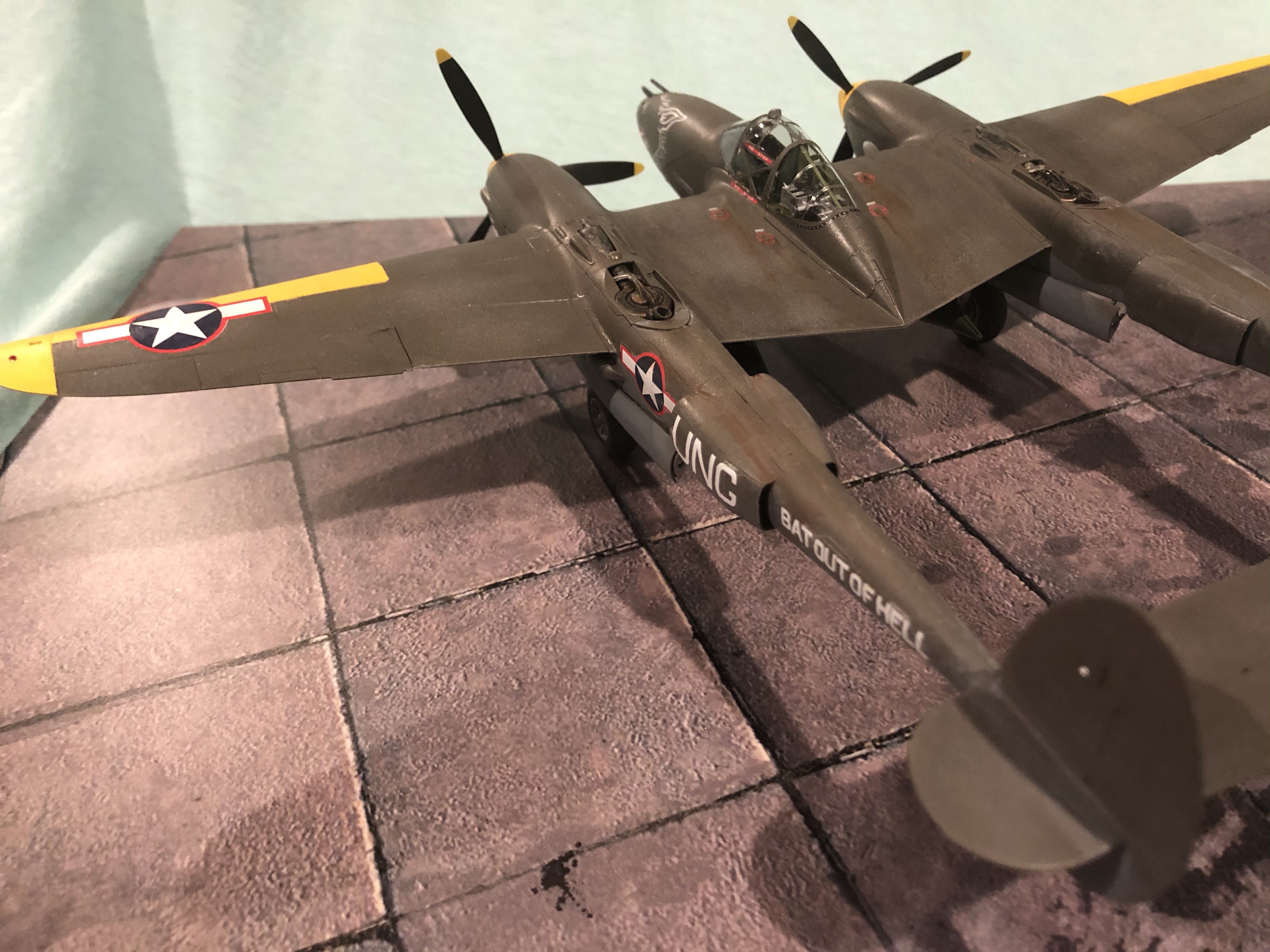
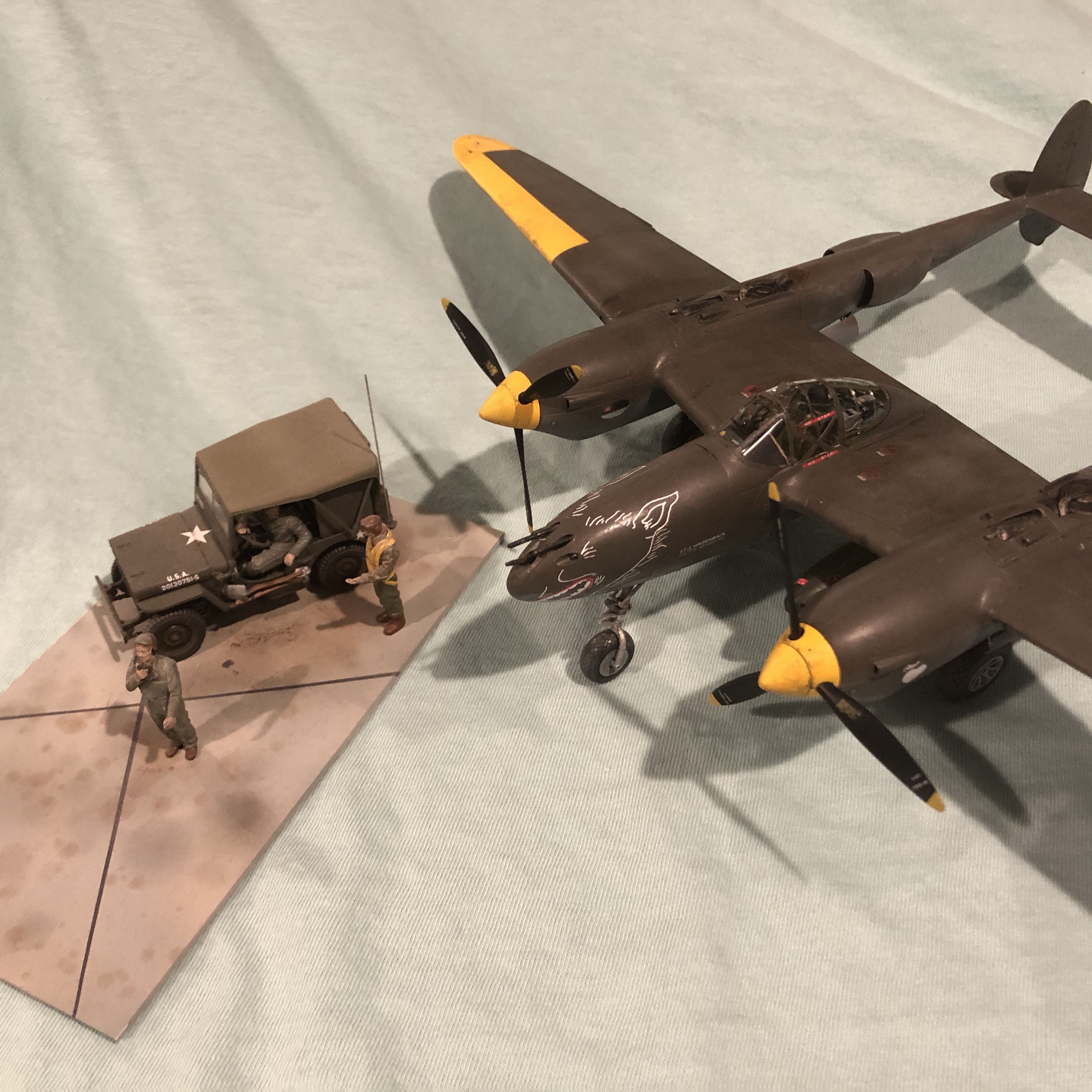
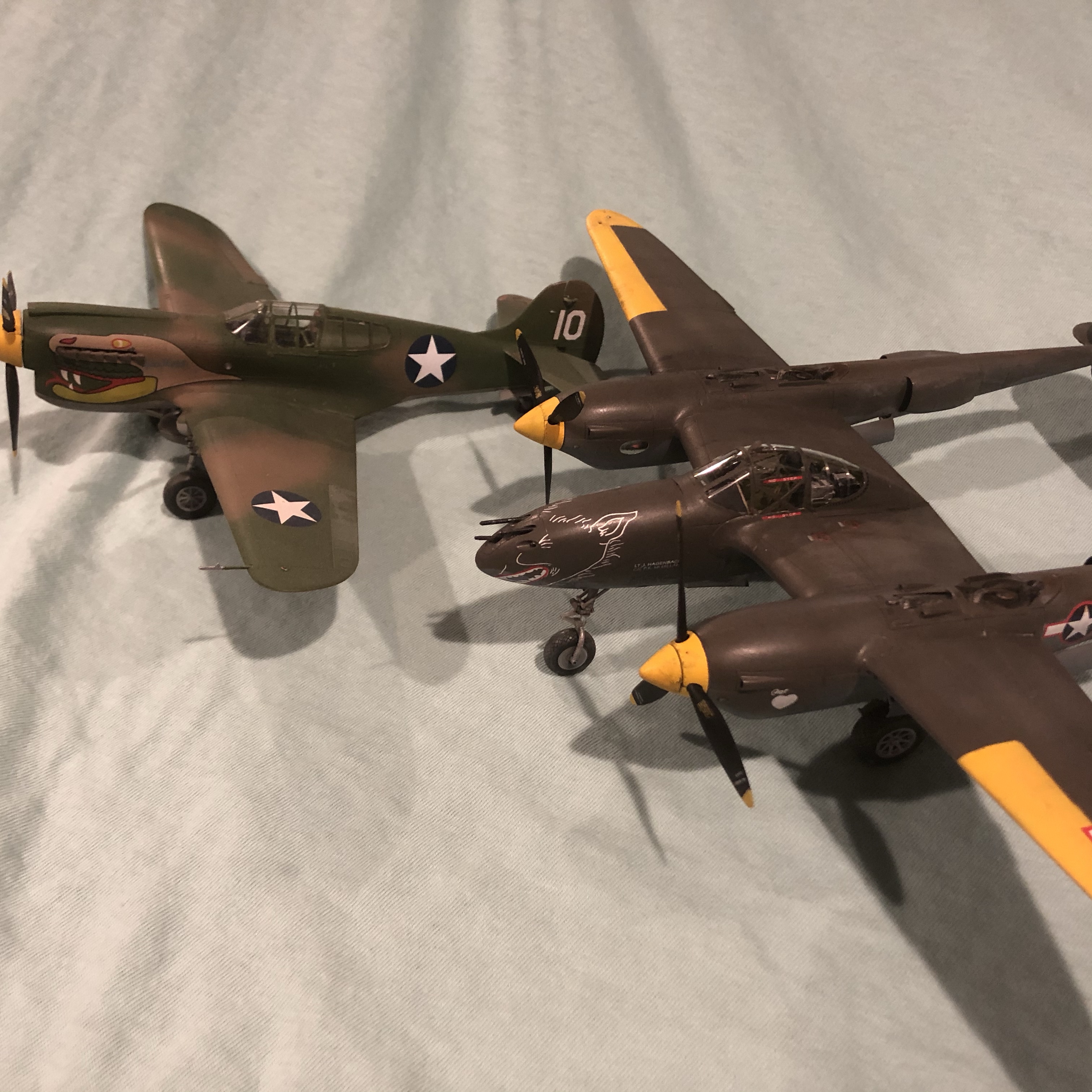
This aircraft was one of the 1st Fighter Group’s early P-38Fs. It survived the North Africa Campaign and was still in use Summer of 1943 even as P-38Gs had become predominant. In fact, the markings seen here represent the 94th Fighter Squadron during the Group’s time on Sardinia. The yellow wings and wing tips identify the squadron. The 27th Fighter Squadron used white (switching to black in 1944 when natural metal planes started arriving) while the 71st Fighter Squadron used red. Seen here, the propeller spinners are also in squadron color; but after joining the 15th Air Force the whole group switched to red spinners. The red outlined insignia was only used briefly that summer of ’43.
“Bat out of Hell” was assigned to1st Lt James Hagenback at this time.
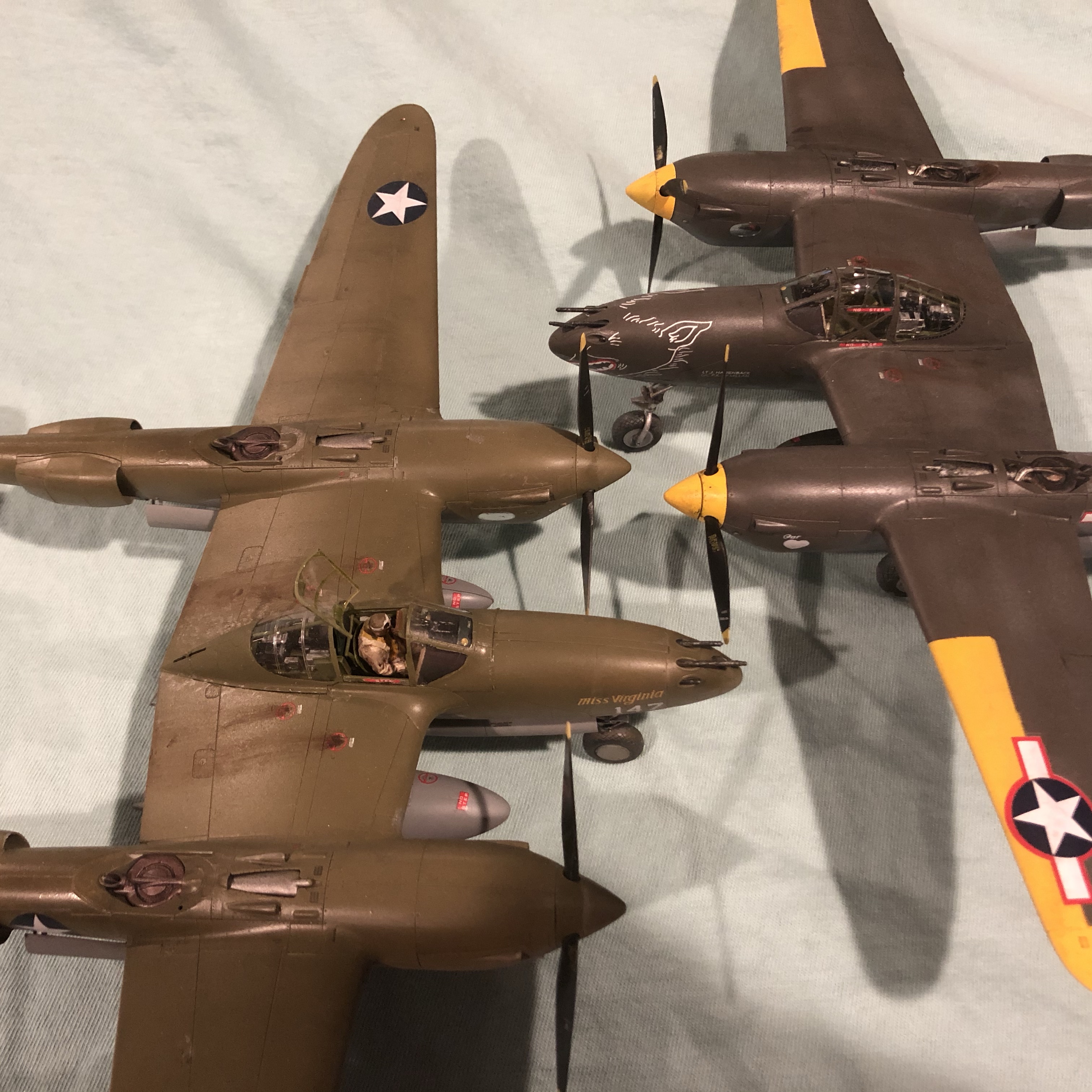
This is the Tamiya kit with Aeromaster decals. Every good thing I said about this kit when I built the “G” I would re-affirm with an exclamation point. (!) What an absolute pleasure to build every step of the way.



That looks great, Dave! I hope some day Tamiya sees fit to scale their P-38 down to 1/72 scale!
Unfortunately predicting Tamiya’s next moves is nearly impossible! I’m hoping they do late model (J/L) Lightnings. Which all probably means they start a new series of 1/24 aircraft…
They have certainly left a lot of money on the table over the years!
No doubt!
It’s a fabulous model you have there Dave, beautifully finished along with an excellent write up. I always thought the P-38 faired much better, maybe in the Far East, so it was interesting to read that it was perhaps not quite the master of the skies I first thought.
It did much better in the Far East.
Basically the roles were reversed between P-38 and P-47 between Germany and Japan as far as which was first choice and which was second.
I did seem to recall that it was highly profitable against Japan. Thanks.
I really enjoyed that. It was really informative, and the story of Glacier Girl was marvellous. I was also pleased to learn that at least one fighter pilot achieved a kill while stationed in Iceland, which appears initially to be a rather quiet place to be stationed.
Thank you!
Iceland sure does seem out of the way. And I bet it mostly was. Probably a good place to send green pilots for their first taste of operational flying.
I seem to recall you mentioned once that the fuel supplied by the British for much of the European theater was lower grade than what we supplied in the Pacific theater and didn’t agree with the P-38.
Yes that was a particular problem in England. I didn’t see it mentioned in North Africa, presumably the US was supplying fuel.
Ultimately the P-38 did well enough in the Mediterranean, even being quite effective in the last year of the War. But the start, largely about green crews learning how to fight a highly proficient foe, went very rough.
Experience was certainly a factor. By the time we entered the war the Luftwaffe had been at war for 3 years. Longer if you count the many that had experience in Spain. It was a steep learning curve in the Pacific too, but we had some excellent tacticians to help out there.
Yeah the Germans were scary proficient. P-38 strengths were also different against them than the Japanese too, most significantly it didn’t have a very good dive speed (low “not to exceed speed” due to airfoil compressibility issues). The zoom climb and pure maneuverability were its biggest strengths.
My stepfather was Lt. James Hagenback, and his aircraft was this model, the Bat Out of Hell.
He was a planner for the raids on the submarine pens of Pantoleria and the Foggia Aerodromes. Later he was a test pilot for the early jet designs, and later the F 86 Sabers. He flew the F 84 Thunderjets in Korea. He finished his career in the early seventies after serving as the Chief of Operations for NATO in Mons, Belgium. He flew in WWII with the 94th “Hat in the Ring” squadron of the First Fighter Group. Not many of that early group came back. Silver Star, Bronze Star, 3 Distinguished Flying Crosses, 18 Air Medals. Legion of Honor. Of all the planes he flew, the P38 was his favorite. He downed two FW 190s and one Macchi with it, and those were fine aircraft.
Wow, Ed thanks for adding all of that! It sounds like he had some good success in the aircraft and went on to a good career.
You mention he planned some significant missions. Was that because of a specific role in the squadron? Or just career military? As a 1st Lt I would expect him to be a section leader, but not senior staff. Sounds like there’s another story there!
His ranking of the P-38 is interesting too. It definitely had a lot of support from those who flew it. I suspect it’s difficult combat debut had more to do with fighting a highly proficient Luftwaffe than anything really wrong with the P-38.
At that time he was squadron leader, and thus was included in the process. I think that by the time Foggia came, he was a Capt. But he was very proud of suggesting an attack formation that was adopted.
The flights flew from North Africa, but towards the Adriatic as though on a bomber escort to Romania/Ploestia so as not to trigger a fighter response. They then assembled and made the attack approach at low altitude below radar, coming from east to west.
The approach was to cover each airfield with a wave of P-38’s wingtip to wingtip in a line. The protocol was NO maneuvering. If a target of opportunity, or suspicious object in the forest appeared in front of you, like a canopy glint or just your gut…give it a squirt. Otherwise, hold formation and keep flying. Each wave was oriented to cover two or more air fields. The result was a massive decimation of the Italian air force.
He was very clear to me that the tactics they were given to fight the Luftwaffe when he arrived were grotesquely inappropriate. It ignored the superior handling features of the Bf109 and the advantages of the P-38. A lot of pilots died following what they were taught before lessons were learned.
Later in the war, the Germans weren’t so cocky about the P-38. The tactics developed in North Africa and Sicily by the USAAC were used to great success against Japan.
But he not only planned the missions, he always flew out front on every one of them. And he always came through the chow line last. It was part of his many lectures to me when I was a young boy in 1957-1958 when he would drive me to the bus stop to go to St. Mary’s school in Tokyo. To be a good leader, one must follow his people.
Terrific response Ed, almost worth waiting 4 years for!
You bring up a lot of good stuff, like the deficiency of early War tactics and the value of lessens learned. Thank you much for contributing here. Your personal connection with the subject is special, that’s awesome.
I know I’d read elsewhere that the P-38s well documented struggles with the Eighth Air Force were also addressed, and not such a major issue by mid 1944. So of course, that’s when the AAF decided to remove them from the theater!
I have done some additional research and learned that my Stepfather graduated from a class of 15, but only 12 graduates. Two washed out, and one was killed in training.
The training aircraft they had were surplus aircraft from the Aleutian campaigns. They were worn and under maintained.
One of the issues they had with these aircraft were carbon loading on the plugs. You had to keep the revs up to maintain heat.
When they trained there were no copilot instructors, so your first flight, and every flight in a P38 was solo.
They would fire up and then march in line to the take off point. Then on signal “GO”. After take of they would each go to a “pie slice” in the sky and go through a set number of maneuver drills, then return. This was so they would not share are space and potentially run into each other.
On one of the later training missions. A fellow pilot, named Garcia, was in the #1 position, and my step father was #2. They gave Garcia the “GO” and he roared down the runway, lifted about 15 feet, and lost an engine from carbon fouling, flipped over, hit the runway, and exploaded.
There was a bulldozer at the end of the runway that scraped Garcia and his plane off, and the order came “Number 2 “GO”.
That is the way it was.
They went to North Africa following the invasion. Within sixty days, ten of them were dead.
The only two survivors were my Step-Dad and Fred Arnold, who went to the 72nd They both survived the war. They reconnected in the 1980’s. Fred was an artist and created a wonderful bronze sculpture piece that is down in the museum in New Orleans.
My step father went on to be the Chief of Operations for NATO in Mons in 1969-1972. He retired after 30 years of service. He was offered many positions in defense industry companies and refused them all. He said they don’t want me, they want my record. That is not for sale. He and my mom lived a modest quiet life in a little seaside town in California called Morro Bay.
Obviously some dramatic stuff there! I’ve certainly heard the training was conducted ruthlessly, but that is a pretty vivid example with Garcia. Wow.
I would guess that casualty rate is extraordinary and unique. Although that said, I know casualties in North Africa were terrible. That was where the USAAF learned to fight the Luftwaffe. And they needed to learn that their pre-War theory didn’t quite match reality, they would need to learn how to use the P-38’s strengths to defeat the highly experienced German pilots.
At least one fighter group (the 14th) was so badly shredded it was withdrawn and nearly disbanded. The attrition even impacted Pacific operations. The type was highly valued for its range, but for a period they were being lost as fast as they could be built. Definitionally that makes it hard to build your strength!
You are completely “spot on” Dave. But we learned, quickly, and made the necessary adjustments in our aerial tactics. Once we did, as we did in the Pacific, the P38 became a formidable platform.
My stepfather Jame Hagenback flew more than 248 missions in WWII. They pulled him out to sell war bonds back home. He then was a test pilot for the early jets, and returned to fly in the Korean War. After he married my mother, he transferred to the diplomatic military mission. He did assistant air attache in Tokyo, then War College in Alabama, then joint force integration with the Navy in San Diego, then Chief of AirForce MAAG to Italy, and then Chief of Ops in NATO.
My stepfather James Hagenback flew more than 240 combat missions in WWII and Korea. It’s about the only thing he ever said about the combat of war. His reflections were usually limited to what life was like on the ground. Like he would never drink tinned grapefruit juice, or eat canned spam meats or dry biscuits again! And he always checked his shoes before he put them on. Living in tents in the North African desert the scorpions would sometimes crawl into their boots at night. He did sometimes talk about mission planning he was involved in (the strike on the Foggia Aerodromes in Italy, skipping delayed fuse bombs into railroad tunnels, things that presented novel tactics and techniques.) Nothing about aerial victories or medals.
He kept the medals in a crumbling cardboard shoe box in the attic. When he was about 75, Mom surprised him with a pair of framed mountings, one with his combat medals and the other with his campaign medals. He initially refused to have them put up in the house. He finally relented but on the condition that he choose the spot to hang them. They wound up next to the door that led to the laundry room from the kitchen. That door was almost always swung open, and covering the two framed presentations! He had the Legion of Honor, Silver Star, Bronze Star, 3 Distinguished Flying Crosses, Army Commendation, 19 Air Medals….He flew F84 Thunderjets in Korea.
They pulled him out just before the effort to take Monte Casino, to sell war bonds back home. He then became a test pilot for the early jets, and returned to fly in the Korean War. After he married my mother, he transferred to the diplomatic military mission. He did Monterey language school to learn Japanese (1956) and then went as assistant air attache’ in Tokyo (1957-1961), then War College in Alabama (1962), then joint force integration with the Navy in San Diego (1963-1965), back to Monterey for Italian (1966), then Chief of AirForce MAAG to Italy (1966-1969), and then his final two tours as Chief of Ops in NATO (1969-1972).
He stayed mentally sharp and physically fit until close to the end. In May of 1998 he did a two week bicycling tour in Norway at the age of 79! In June he felt a bit ‘punk’, and the docs discovered he had pancreatic cancer. It was not operable, and he passed in late October. He wanted no service, no headstone. His wish was to be cremated and his ashes scattered over the sea. So it was done.
He was a great father and role model to me. He spoke to me as though I was a nine year old for almost all of my life, well into my forties! He rarely spoke even in social gatherings. Never cursed, never rose his voice. I never once saw him flustered or angry about anything. But he was dead serious, and when he did speak, you had better pay attention!
When I left home to go to college, that was pretty much it for me. He and Mom were in Belgium, I was in the US. But for the next four years he wrote a handwritten letter to me every single day, weekends and holidays included. The day I graduated from college was the last letter.
I still miss him, a lot.
Thank you Ed for this wonderful contribution. Your personal connection to Lt Hagenback is obviously significant. And a beautiful testament to the fact these men I write about are real people.
And its amusing to hear his ambivilence about his decorations. But from what I’ve seen that is not uncommon for that generation. Honest humility is very different in this age of “influencers”.
So I am pleased to see this up, it will stay for however many years this site stays up!
Thank you Dave.
Col Hagenback, that’s how I knew him, had pilot friends who would come visit and have dinner with us from time to time in our home over the years. Chuck Yeager came by a few times. They knew each other from testing planes at Muroc. They had rooms at the BOQ there.
He worked with Gen. Minoru Genda of the Japanese Self Defense Forces. Capt Genda was the chief planner for the attack on Pearl Harbor for Admiral Isaroku Yamamoto (who studied at Harvard. He had seen the steel foundries in Pittsburgh, the oil fields in Texas, the farmlands in the midwest…..and argued against going to war with the US. He understood the essential nature of industry in modern war and the limitations of Japan’s capacity). Together they were focused on rebuilding Japan as a defensive position against Russian and China. As you know from history, it was an attack with P-38 Lightnings that took down Admiral Yamamoto.
He worked with senior officers of the self defense forces in Europe to build an integrated air force power to deter the Eastern Block in the 1970’s.
During my Sophomore year at Harvard, he called me in December and asked if I could catch a flight to Belgium and spend Christmas Holiday and early January with the family. And bring my tuxedo. It was possible, so I grabbed a flight the next day, using space available on military transport to get back. A C 141 flight sitting in webbing with knees interlocking with the troops in the row facing opposite. It was “free”, but not worth that. That took me from New Jersey to Ramstein in Germany, and a couple of train connections later they collected me in Brussels.
Turns out Mom had a bad case of flu and could not possibly attend, and the next day there was a special reception at Supreme Headquarters Allied Powers Europe. (S.H.A.P.E.) It was something done every quarter I think. A member of NATO would host a reception for senior officers around Europe. It would feature classic wines, cheeses, meats and culinary specialties that the host country was proud of. This particular event was hosted by the German Self Defense Forces.
Now, the Germans are our friends. But they are not going to be any combat ribbons or Iron Crosses! Nor are the Italians. The French didn’t have much to sport since they dropped their rifles in 1940. So basically it was the Brits, Greeks and the Finns.
This was black tie and tails, the officers had those miniature medals, a string quartet was playing classic German odes….it was most impressive for a 19 year old boy.
I asked dad what do you want me to do? And his response was “keep your mouth shut and follow my lead.”
OK. I can do that without understanding what is going on.
About an hour into the evening I have seen twenty senior officers from different nations walk up, introduce themselves and gush over my stepfather. What the heck?
Then, a German Lt. General comes up. He has a glorious Mosel River Riesling, the incomparable Doctor. He hands a glass to my dad, and they start talking. The German officer then, looking at my father’s campaign ribbons says…..’ah, I see you were in North Africa and Sicily’. My father says “yes”. The German then says, I flew in North Africa and Sicily. This gentle probing goes back and forth interspersed with appreciation German sausage, cheese and wine.
Then the German says………..”You were the bat, of the 94th!”.
And my father smiled and said……”You were the yellow spinner of the Goering Division”.
There were some seconds that passed as they looked at each other.
They both turned, handed their wine glasses to me, put their arms around each other, and walked to the bar for a proper libation. Or more.
When the evening wound down, and my Dad came to collect me, we walked to the car and as we buckled up for the ride home I asked. “Dad, what did you talk about for s long?” He just smiled and said, ” it wasn’t anything for you.”
Holy smokes that’s a great story! And I meant no disrespect on the rank, I did not know he had risen so high.
It is always an amazing thing how so many were able to build friendships across the wartime divide.
They were warriors and patriots fighting for their countries. And of the long seasoned veterans, they were the few. The survivors. The war was over. They were both involved in rebuilding. I doubt either of them ever finished healing.