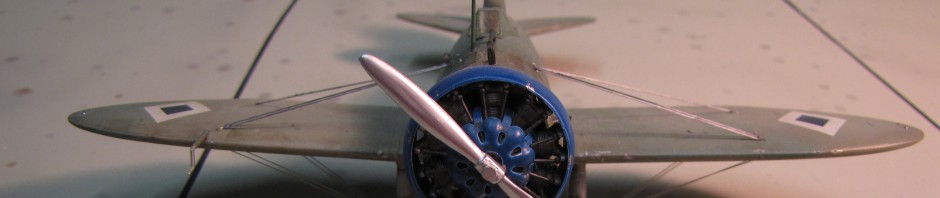
Messerschmitt’s Bf 109 was one of a handful of types that was in service from the first day of World War II to VE Day.
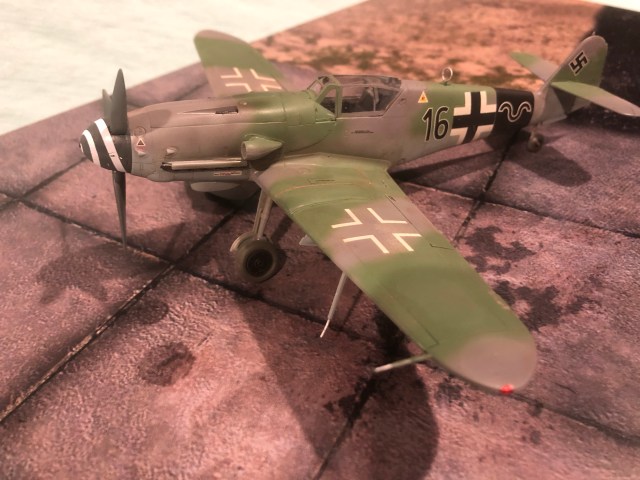
No doubt it developed a great deal over that period. Let’s take a look at the final variant to enter service.
The Bf 109G was the most produced, and I believe the best known late-War variant of the type. But it was built by several manufacturers in a variety of sub-types. The G-6 was mass built, the G-10 added power, a tweak to that became the G-10/AS. From G-1 to G-14 there were a lot of changes. Each manufacturer also made some of their own changes. And a staggering number of manufacturer and field modifications were cataloged.
Which makes for a complicated designation system and parts inventory.

The black band around the rear fuselage designates the plane as a part of JG 53 during late-War “Reich Defense” operations.
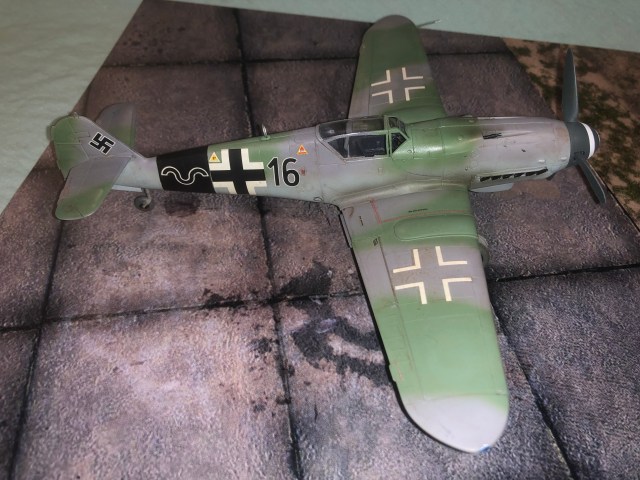
The Bf 109K was an attempt to rationalize all of that. With a focus on making a high altitude interceptor for opposing the US 8th Air Force, the best features were put together in a single spec. This included a smooth cowling without the characteristic machine gun bulges, an “AS” type engine with water injection capable of nearly 2000 hp, and more aerodynamic air intakes under the wings and fuselage. I *think* the only feature unique to the Bf 109K was a retractable tail wheel and outer covers for the main landing gear.
This all made it the fastest and best climbing variant of the well known fighter. Well, excluding some test aircraft (!). As the “K-4” version it entered service in August of 1944 and continued until March of ’45 when all Bf 109 building came to an end. It never fully replaced the “G” across all manufacturers, except to say it was the last type in production for the last couple weeks. About 1500 of the K-4 were built. A prototype for what would have been the “K-6” flew fall of 1944, but I don’t believe that sub-type ever made it into production.
Whatever the Bf 109K’s virtues may have been, it was another of Germany’s too little, too late weapon systems.
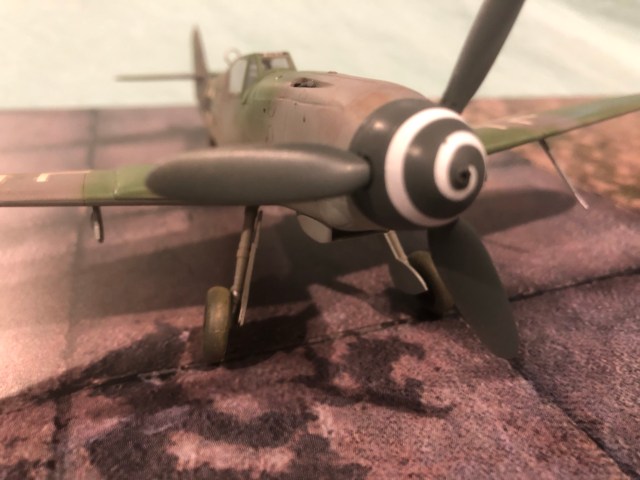
The object hanging down on the wing is the outer gear-well cover. I believe this feature is unique to the Bf 109K. Firepower is two 13mm machine guns and a single 30mm cannon firing through the propeller spinner.
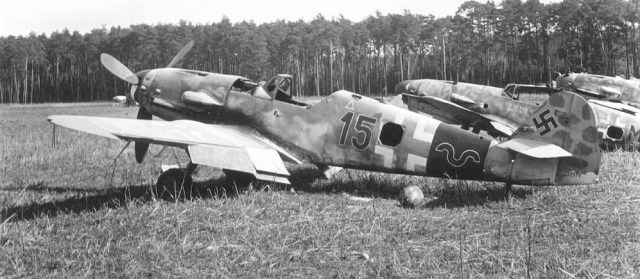
A line up of captured Bf 109K-4 at War’s end. This is Black 15 from JG 53.
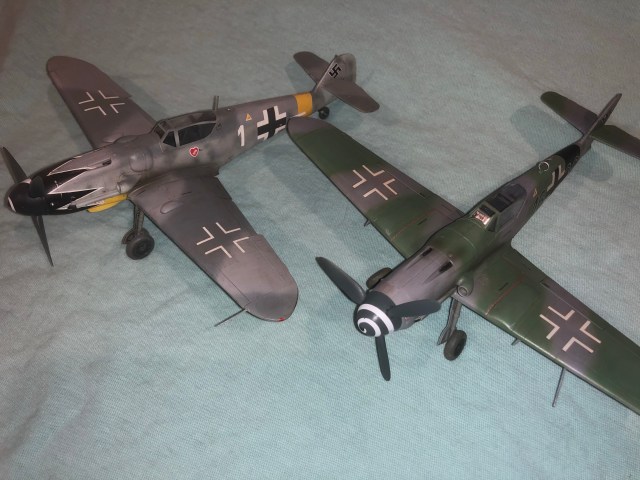
A Bf 109G-6 alongside a Bf 109K-4. The bulges forward of the cockpit on the “G” were added when the cowling mounted machine guns were upgraded from 7.92mm to 13mm. On the “K” (and some “G” models!) the fuselage was flared out to remove the bulges and improve aerodynamics.
This particular aircraft was assigned to JG 53 in the closing weeks of the War. It is from the Hasegawa kit.
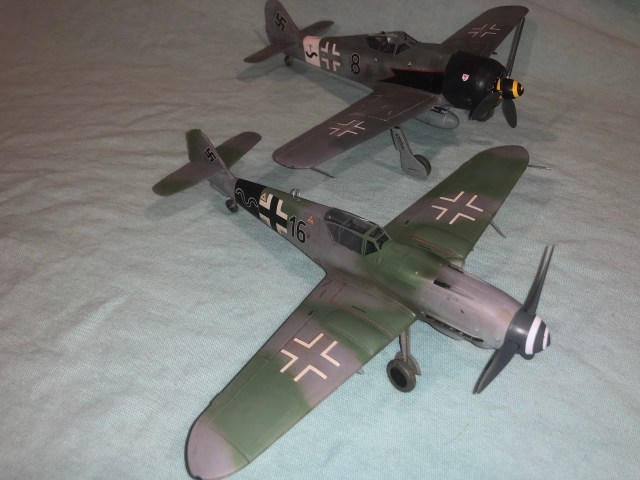
In theory, the Bf 109 was to go after the escorts while more heavily armed and armored Fw 190s attacked the bombers. But Goering and Hitler became strident on all fighters going after the American bombers.
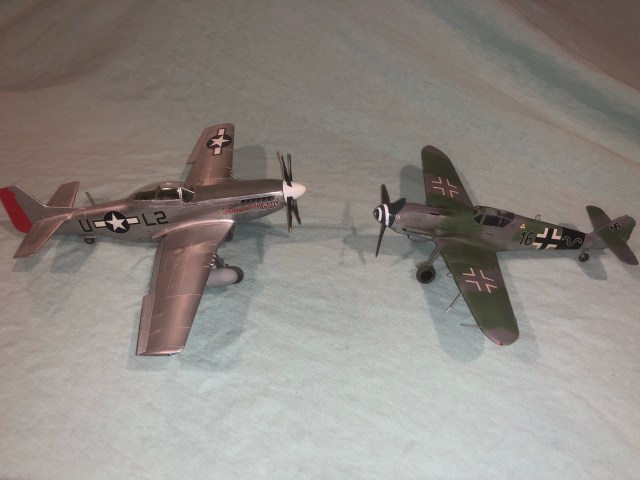
High flying escorts like the P-51D shown here had become a major problem for the Luftwaffe. The Bf 109K utilized all the best altitude and climb related features of the Bf 109 family. It clearly had the best rate of climb of anything in wide use.


 Plane Dave
The Bf 109, in all it’s variants, is probably my favorite single pilot fighter of the entire WWII era. The panes lines, performance and sounds make me think the German pilots must have felt the same what I do when I frites my flat-six Porsche! Thanks for the walk around! Great post.
Thank you Eric!
And have no worries when hear that hemi Challenger closing on your six; it is definitely NOT a Thunderbolt chasing you down… but it might be a Hellcat!
It’s the last tweak of an early 1930s design, but it’s so tiny! And as for the model, well, anybody who can paint the propeller boss with that spiral design gets my vote!
Thank you, but sadly that is just a decal. Even worse, I messed it up once and had strip it and redo!
It is, like a late Mark Spitfire, the ultimate of 1930s design!
The 109 was an excellent aircraft and certainly a match for allied aircraft. The model’s terrific as always!
It was certainly capable throughout. Very impressive for its relevance to the very end.
Although to my mind its always first and foremost a “target”!
Well in the later stages of the war, as the “average” pilot was less and less experienced, I’d say that definition probably got more and more descriptive.
Yeah ultimately it was at the training level where the Luftwaffecouldn’t keep pace. Their hardware was mostly adequate. Although I think, apart from rate of climb, a Mustang or Thunderbolt could handle a 109 or 190.
One interesting thing about the 109 that maybe you can explain. Unlike almost every other fighter in the European theater the 109 kept the “greenhouse” canopy in the flush or “razorback” configuration whereas almost every other fighter went for the bubble canopy eventually out of both weight and visibility concerns (though there were tradeoffs as I understand it). Even the FW190 eventually went with the bubble canopy I believe, but the 190 stuck with the original design. Any particular reason?
I think it would have been a bigger redesign than they wanted to do. The canopy was improved, less metal and more plexiglass. But the fuselage was already pretty minimal, it would have been hard to cut it down further. Maybe raising the seat into a blown bubble? But that would involve a whole cockpit redesign, so more engineering than they wanted to do.
There was constant work on a replacement for the type, that would have included a more modern cockpit; but for a number of reasons it never came to fruition.
This is taken directly form wikipedia: The Me 309 project began in mid-1940, just as the Bf 109 was having its first encounters with the Spitfire in the Battle of Britain, the first aircraft to match the 109 in speed and performance. Already, Messerschmitt anticipated the need for an improved design to replace the Bf 109. The Reich Air Ministry, however, did not feel the same urgency, with the project given a low priority, resulting in the design not being finalized until the end of 1941.
The new fighter had many novel features, such as tricycle landing gear (with a nosegear strut that twisted through 90° during retraction, to a “flat” orientation under the engine) and a pressurized cockpit, which would have given it more comfortable and effective high-altitude performance. Each of the new features was first tested on a number of Bf 109F airframes, the V23 having a ventral radiator, the V31 with a radiator and tricycle landing gear, and the V30 having a pressurized cockpit.
Low government interest in the project delayed completion of the first prototype until spring 1942, and trouble with the nosewheel pushed back the 309’s first flight to July. When it did fly, the Me 309’s performance was satisfactory – about 50 km/h (30 mph) faster than a standard Bf 109G – but not exemplary. In fact, the Bf 109G could out-turn its intended replacement. With the addition of armament, the aircraft’s speed decreased to an unacceptable level. In light of its poor performance and the much more promising development of the Focke-Wulf Fw 190D, the Me 309 was canceled.
There was a bubble canopy involved, but a “blown type” with metal perimeter framing was waaaaay to advanced for the Reichsluftfahrtministerium. The design was bubble shaped but made from several panels held together with one large aluminum frame. By the way, even then it did not slide back, but opened on one side, just as always. Although it was a handsome, modern looking aircraft it’s performance was sub- par and dropped.
Yes I wrote about this at length in my “Me 509” post.
Messerschmitt knew he could do something more advanced, but the RLM dithered until it became clear jets were the future.
On the one hand, I think the RLM sort of lucked into being right. They had no clue, but were correct that Messerschmitt was offering a marginal improvement, when something revolutionary was just around the corner.
On the other hand…
German jet technology was NEVER mature during the War years. And they lacked access to the metals to make it mature. So it might have served them better if they’d taken the marginal, and skipped the revolution.