
Another look at a combatant from the least known of the major theaters of operation.

Let’s take a look at a successful CBI pilot and aircraft.
A mild curiosity, this is the first “P-51C” I’ve done. The only difference from a “B” model is that the “C” was built at North American’s Dallas plant instead of home-base Burbank. This little distinction is not unique, but later in the War USAAF did not consider location in assigning letters (the “P-51D” could come from either plant).
This particular Mustang has an uncommon modification, the vertical fin has an extension forward along the spine. Much like most P-51D models. But on the P-51D the fin was extended specifically to make up for the loss of vertical surface area when the fuselage was cut down for the bubble canopy. Why do this on an earlier Mustang? Apparently some of the early Merlin Mustangs suffered damage, even catastrophic loss of the tail due to high “G” combat maneuvers. North American produced a re-enforcement kit, in the form of this fin extension to correct the problem. I don’t believe this was ever installed at the factory, but showed up on many B/C model Mustangs that were still in service towards the end of 1944.


The 311th Fighter Group was first activated in January 1942 as the 311th Bomb Group. In July 1942 they were redesignated 311th Bomb Group (Dive). Then in September 1943, in preparation for shipping out to India, they were redesignated again as the 311th Fighter-Bomber Group. This last change was important as it represented one of the component squadrons would be re-equipped with fighters. The “Bomber” squadrons (528th and 529th) would deploy with the A-36, the dive bomber variant of the Mustang while the 530th Fighter Squadron had P-51A Mustangs. Based in India, and later Burma, they specialized in close support for operations in north-eastern Burma, the 530th also provided fighter escort for the dive bombers and local transport aircraft. They also often joined with the 459th Fighter Squadron’s P-38s, as 10th Air Force’s only long range fighter squadrons these two were called on to escort B-24 and B-25 missions. Between them, these two squadrons generated the most kills and the most aces for that Air Force.
In May 1944 the group was again redesignated, this time as the 311th Fighter Group when it was decided to re-equip entirely with Merlin Mustangs. In August they were re-assigned from the Tenth Air Force to the Fourteenth Air Force and were relocated into China for the rest of the War.

Markings were an interesting jumble during much of this time. The squadrons were identified as “Red”, “White” and “Yellow”; propeller spinners were apparently painted to match squadron assignment. But given the nature of operations at the end of a long supply line, parts and even whole aircraft were swapped haphazardly between squadrons and ultimately spinner color meant little or nothing. The Group markings involved the yellow tail, and two black stripes. But the black stripes could be angled as seen here, angled oppositely, or vertical. Any meaning to this is completely undocumented as far as I can tell.
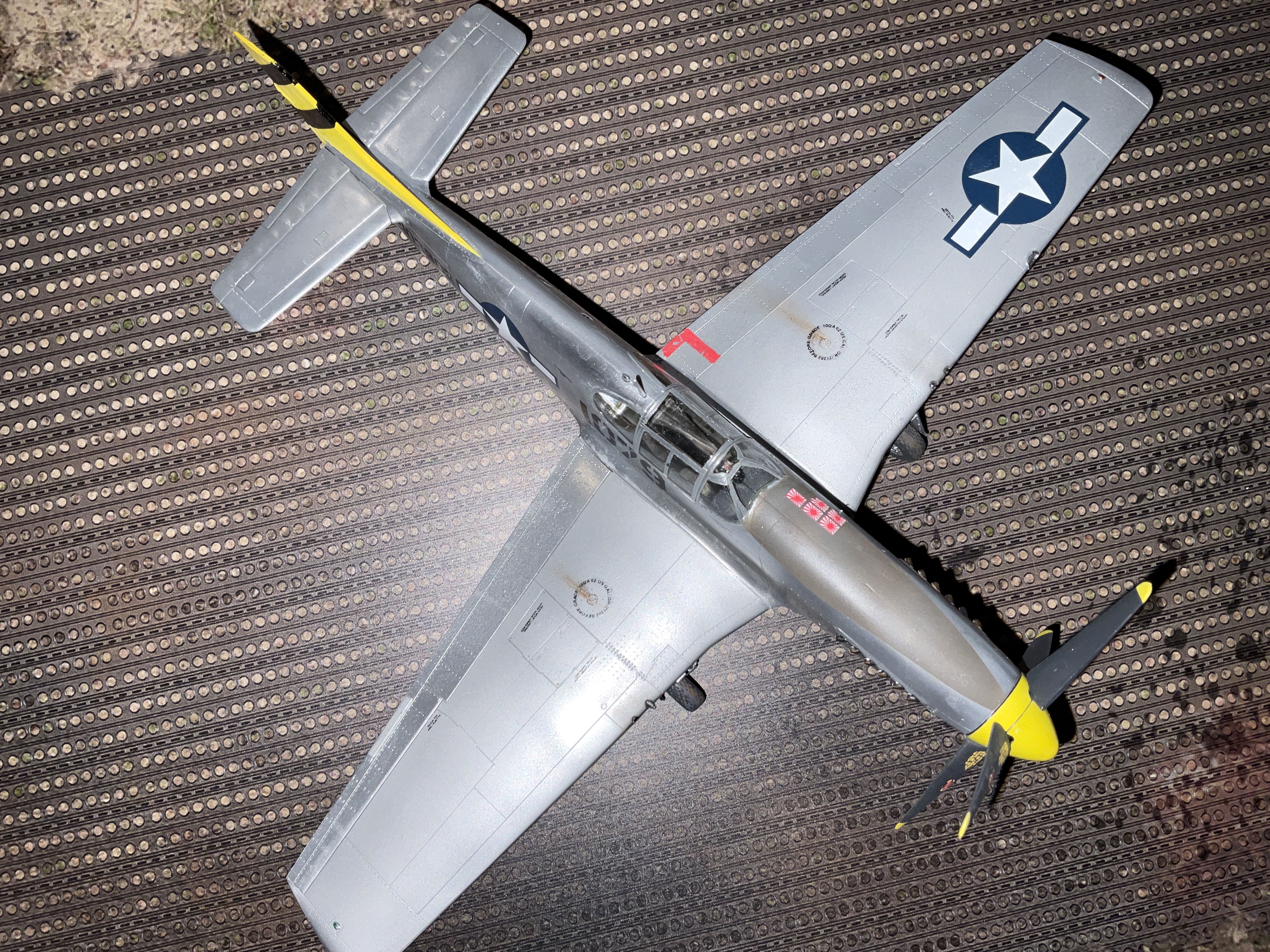
The plane shown here, “Penny” was flown by Lt Lester Arasmith in late ’44 to early ’45. He was one of only two 311th Fighter Groups pilots to make ace during their time with the 14th Air Force. On March 24, 1945 he scored his sixth and final victory. He won his first of three Distinguished Flying Crosses during World War II, his last in Viet Nam. In between, he was credited as “Technical Advisor” on the 1955 quasi-documentary “24 Hours Alert” produced by Warner Brothers and Disney. He retired as a Colonel in 1969 and passed away in 2019.


This is the Accurate Miniatures kit. As far as I know, its the only kit that allows for the fin strengthener right out of the box. Not that it would have been an extremely difficult modification! But this is a pretty easy and fun build, doesn’t quite fit as well as the Tamiya kit (which is roughly the same age), but its not difficult in any sense.


 Plane Dave
Very nice build. I’m a big fan of the pre-D Mustangs, even though they don’t look as cool. Also I’ve always been curious about the CBI theater and the quirks and compromises they reached at the end of the very long supply chain. Also a good reminder that it wasn’t always as simple as cutting down the fuselage and sticking a bubble canopy on it to move to the next model.
The thing that most surprised me on writing this up was discovering that 10th Air Force only had two squadrons of long-range fighters through 1944! Obviously the need wasn’t so great either, but any mission for Rangoon or further meant 350th FS and/or 459th FS, that’s it! Then when the 311 FG converted to all fighters, they were moved to China. Seriously limited resources.
I do enjoy doing the earlier Mustangs. No doubt the “D” is iconic, and beautiful. But the B/C had such a huge and shocking impact on the War, its fascinating to read about.
That was really interesting and thank you for sharing it. I don’t think I’ve ever seen that fin extension on a P-51C before, but to be honest, I do wonder if I have, but just never noticed it.
I don’t think I noticed for many years. And when I first did, I thought someone was being silly and trying to make it look more like a “D”!
Hi! I found your site while looking for accurate images of a P-51C to see if one of the planes in the recent series “Masters of the Air” was correct (I’m still not sure-). One thing that caught my eye was your use of PSP (pierced steel plank, or Marston mat) as the base of your excellent model. I am always on the lookout for pictures with this interesting and sturdy material, as it was made in vast quantities and shipped all over the world, including Panama, where I grew up as a kid in the Canal Zone. About 15 years ago I decided to replace my poorly paved driveway in Austin, Texas and managed to get about 60 sheets of WW2 PSP as the permeable hard surface I was looking for. As my wife exclaimed once the project was done, “This turned out better than I expected!”, and the resulting driveway will probably outlast my house despite being 80 years old at this point. It’s great stuff, if you can find it. Your comments about the differences between the C and D model P-51s were also educational. Beautiful aircraft! Thanks!
Thanks for your kind words!
I think the only real distinguishing characteristic of a “C” as opposed to a “B” would be the serial number. So it’s possible many are mislabeled as B models. Do you recall what detail struck you wrong? I might know a resource!
I’ve been mostly pleased with Masters of the Air, overall a very well done series. I did read the Donald Miller book many years ago, but honestly don’t recall enough detail to remember all the “who does what” sort of details.
So many of the production details seem right on. although I guess they only did an “F” model on the B-17! It’s conspicuous as we start seeing silver planes, but still no chin turrets! Maybe because they had to build physical assets apart from just the CG? The fighters are obviously a secondary story, but even so we’ve seen Thunderbolts and two models of Mustang.
that’s funny about the PSP! That has to be an interesting looking driveway. A few years back I found several printed plastic cards to use for bases. I like using a fitting surface the subject rather than just posing them on the background fabric. It puts them more in their element, while not quite involving a true diorama.