
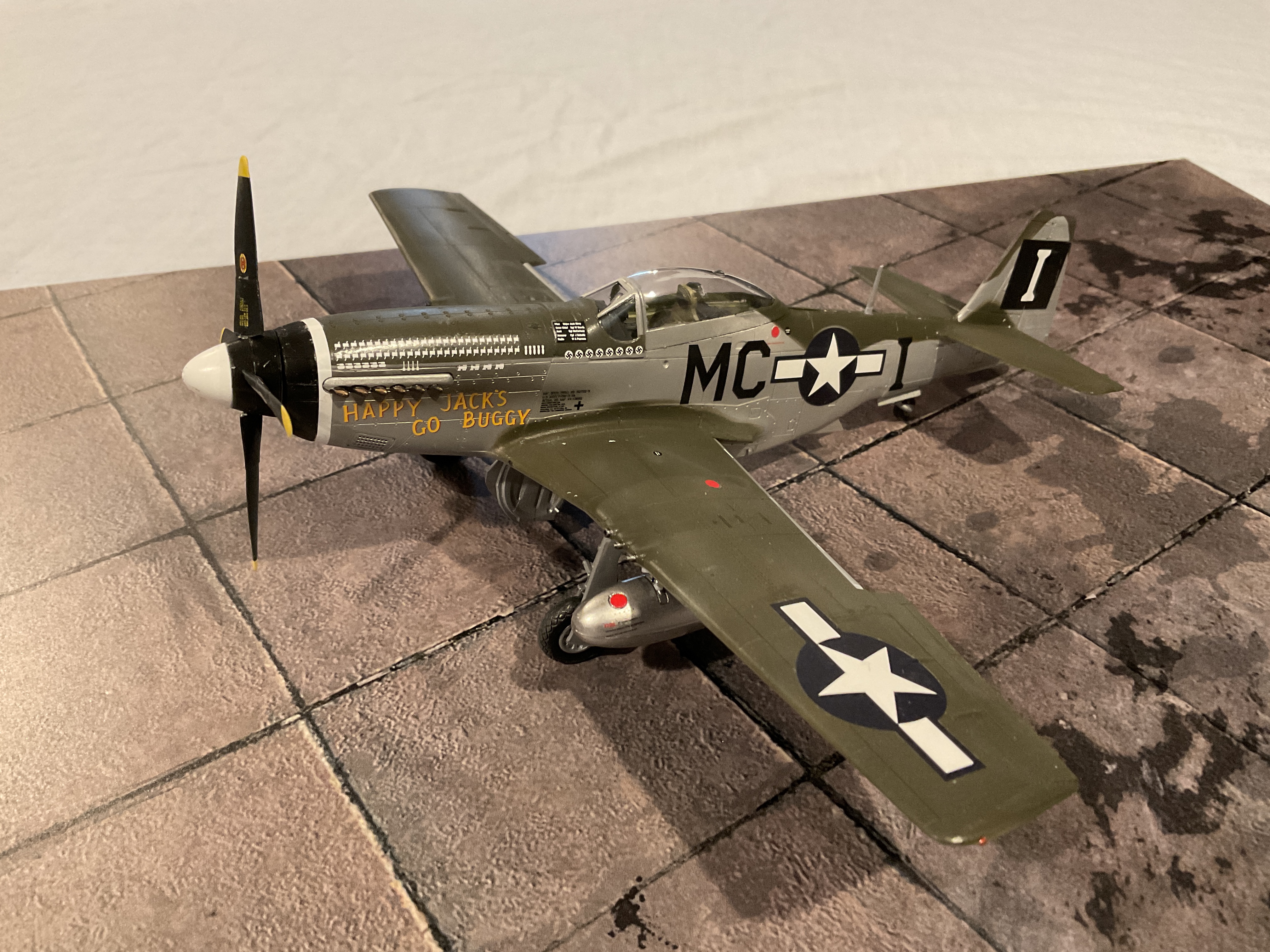
Let’s take another look at the ubiquitous symbol of 8th Fighter Command’s domination, as flown by a successful and interesting pilot.
This Mustang was the mount of Major Jack Ilfrey. He actually saw most of his success as a P-38 Lightning pilot, but he finished out the War in the plane seen here.


Jack Ilfrey was born in Houston Texas in 1920. He entered the Army Air Corps in April, 1941 and graduated from flight training the week after Pearl Harbor. He was then assigned to the 1st Fighter Group, training up as a P-38 Lightning Group on the West Coast. He was a part of the big trans Atlantic ferry flight that left some planes behind in Greenland (by accident) and Iceland (on purpose). That spring the 1st Fighter Group flew fighter sweeps over Europe.
In November 1942, Ilfrey had his first serious excitement. 1st Fighter Group was flying from England to North Africa to join that campaign. Over the Ocean Ilfrey noticed his drop tanks weren’t feeding correctly and he made an emergency landing in Portugal. Local officials informed he would be sitting out the rest of the War with them, but would he please show them how his airplane worked? He apparently convinced them he needed fuel to demonstrate anything which they provided. Then while giving a Portuguese Major a cockpit briefing, with Ifrey in the pilot’s seat, he jammed the throttles forward and made a clean get away with the Portuguese pilot taking a tumble to the runway.
On rejoining his group in North Africa his commanding officer was furious with him for maybe starting an International incident! 12th Air Force Commander Jimmy Doolittle was more amused however, and blocked any action against the young pilot.
Ilfrey named his P-38F “Texas Terror”, and may have become the War’s first P-38 ace with 5 1/2 kills in North Africa.
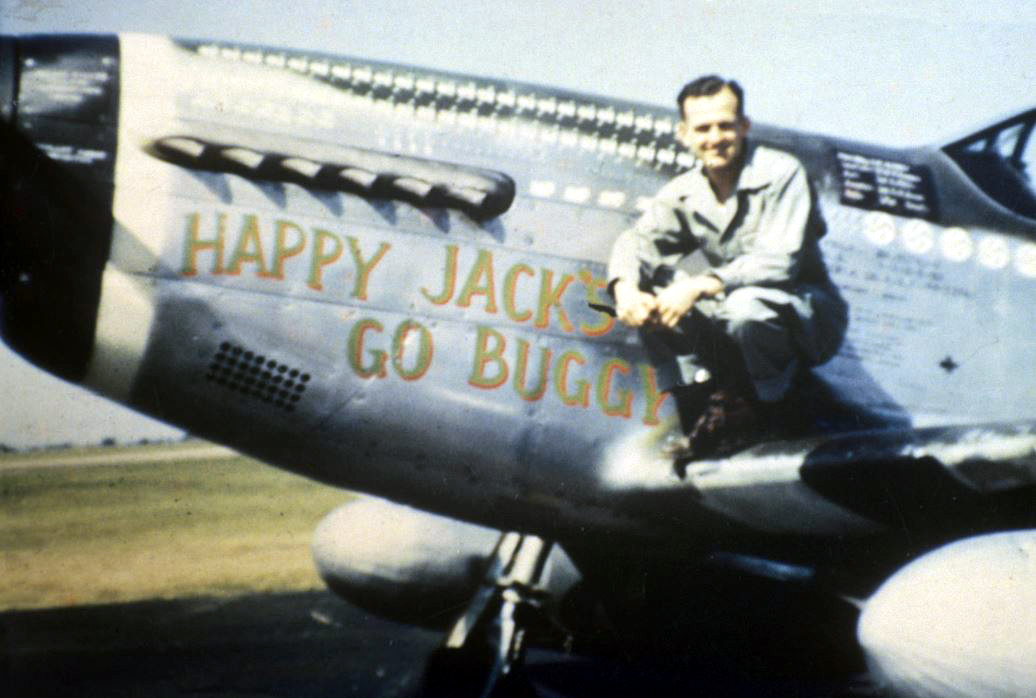
In 1943, tour expired, he returned to the States and was assigned to the 20th Fighter Group. The 20th was another P-38 group. In mid-1943 it looked to be the long-range fighter the 8th Air Force was needing. So the Group was trained and shipped out as quickly as possible. By the time they actually deployed it was becoming obvious the P-51 Mustang was the plane the 8th had been looking for, but the 20th Fighter Group would spend several months yet in P-38s. Capt Jack Ilfrey was issued a new P-38J. His ground crew had taken to calling him “Happy Jack” because of his happy demeanor, so his plane became “Happy Jack’s Go Buggy”. He scored two more kills in May 1944, the second was a Bf 109 he took down by ramming. The P-38 won the encounter and returned home minus four feet from its right wing.
The week after D-Day he was involved in an attack on a rail bridge. He sighted a locomotive and went after it, only to be hit by heavy ground fire. He bailed out when his plane burst into flames. But he was low, and his parachute had barely opened when he hit a farm house roof. Apparently no specific injuries were recorded beyond being pretty shook up. He was rescued by the friendly French farming family; who provided him with a change clothes, a bicycle, and a false identity as a deaf-mute! He made his way back to Allied lines, and was back with his Group in England a week after he took off. Most pilots who escaped occupied France were grounded on return, so they couldn’t let slip anything about the Underground network if they were later captured. I don’t know exactly why Ilfrey was exempted, perhaps where he came down had already been liberated?
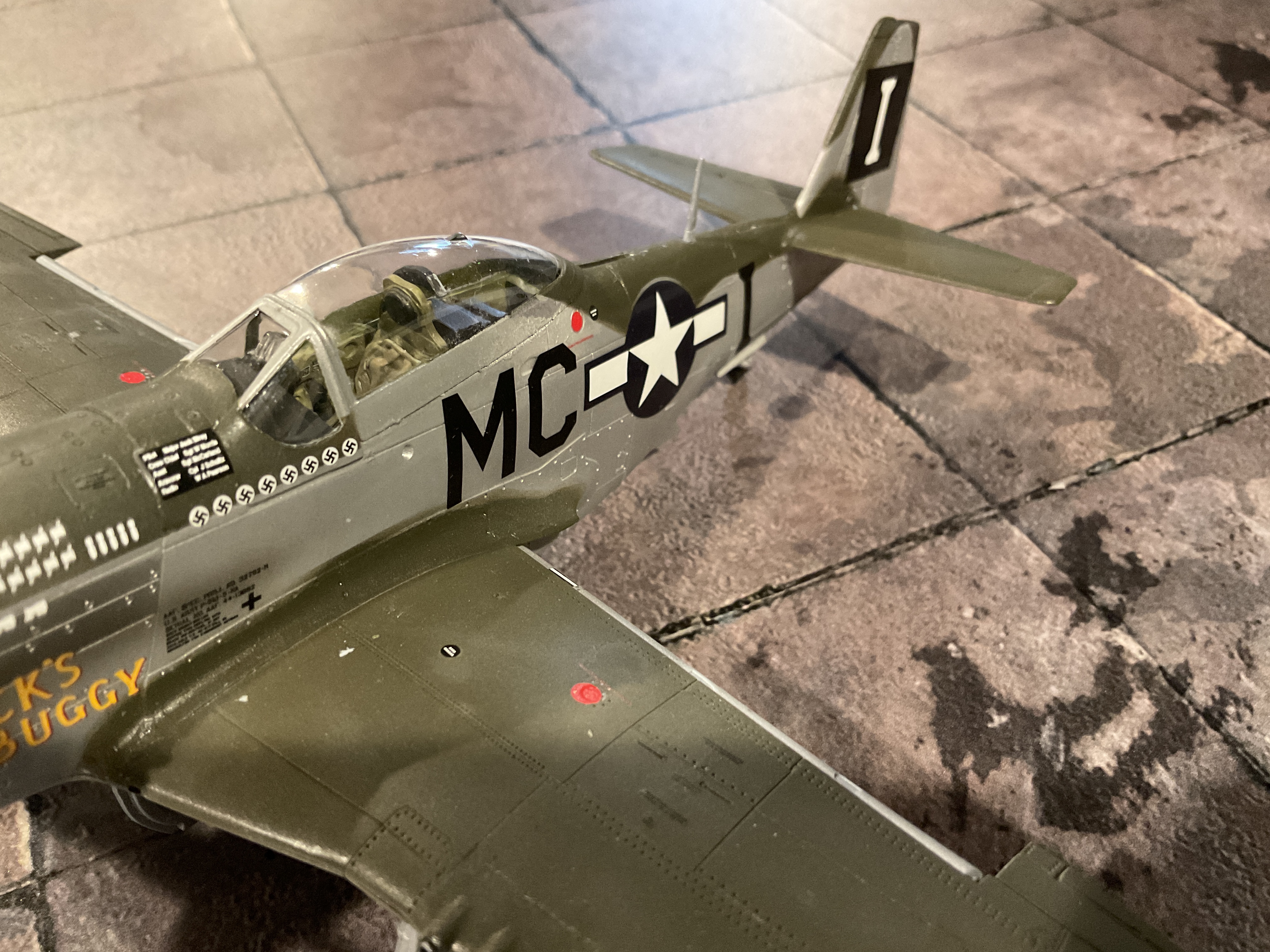

The 20th Fighter Group was now converting to Mustangs, and Major Ilfrey was issued a new P-51D-5. When he was given command of the 79th Fighter Squadron, the ensuing party at the base led to him being busted back to 2nd Lieutenant… but apparently still the Squadron CO. In November he had an adventure in this aircraft, he landed behind enemy lines to pick up a downed squadron-mate; they made it back to friendly lines in Belgium. He flew this plane to the end of tour, and finally returned home in December 1944.
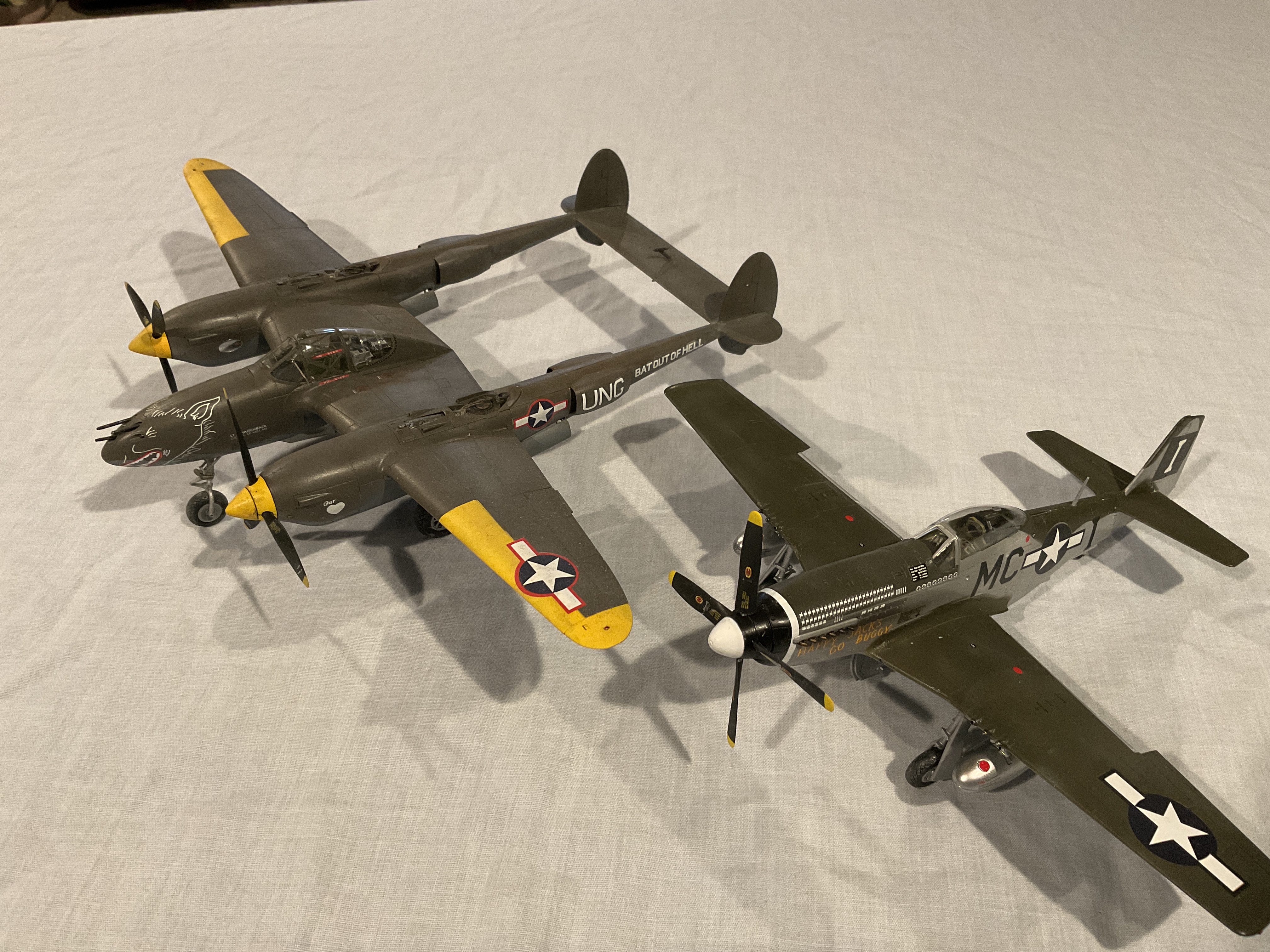
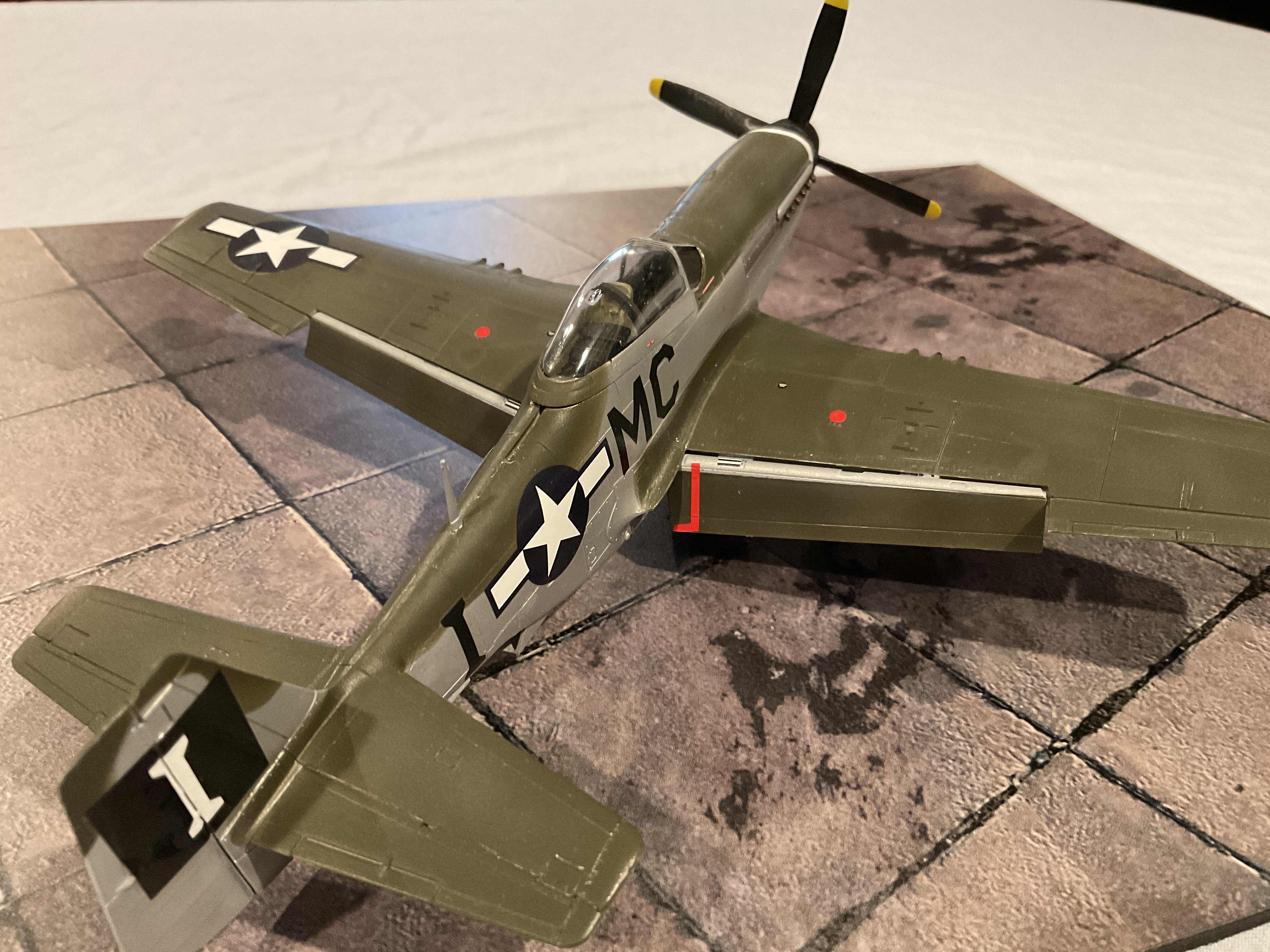
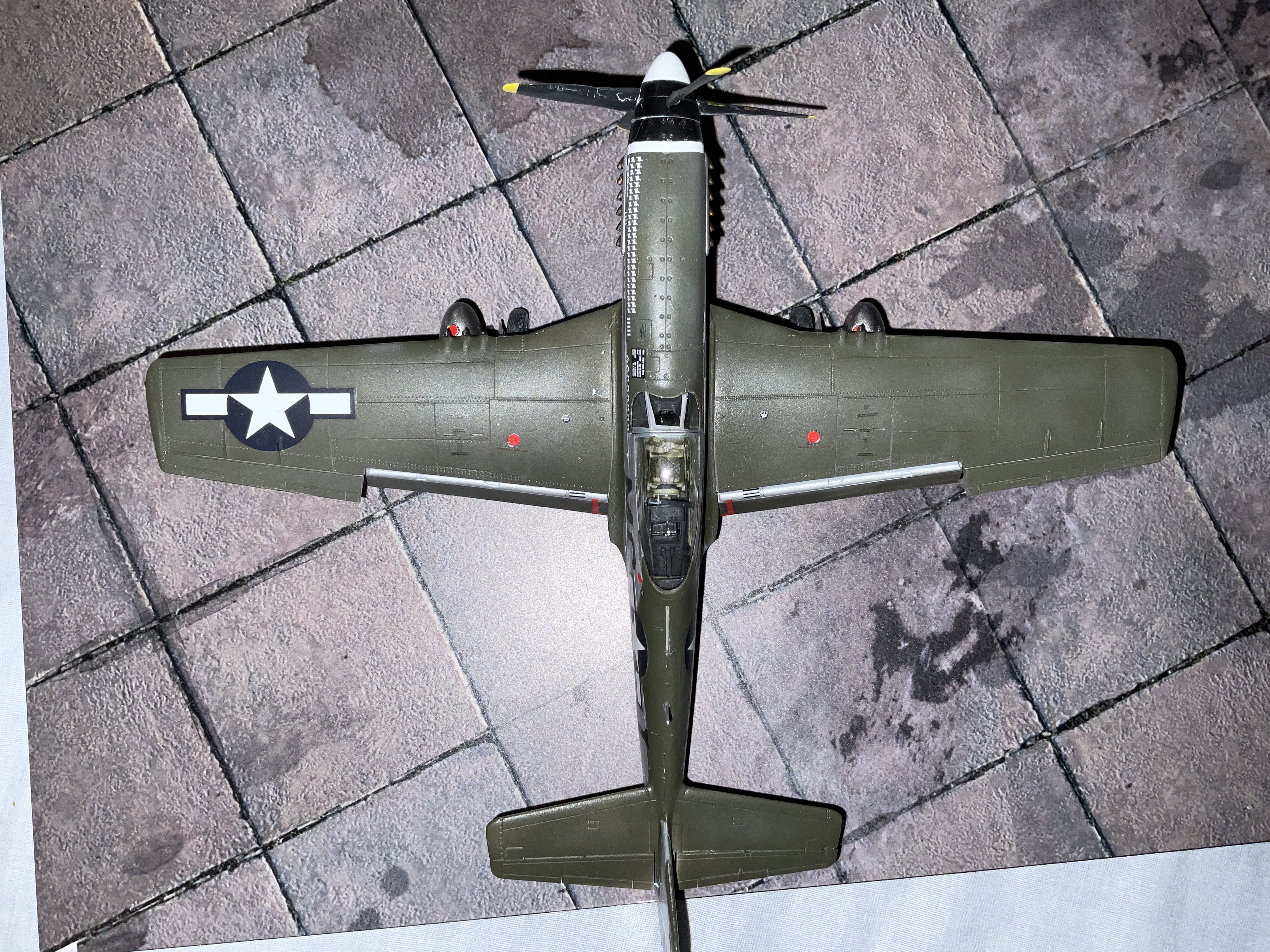
Of course this airplane is that plane Jack Ilrey was issued in July 1944. As an early “D” Mustang it lacks the vertical fin extension usually seen. I believe Happy Jack’s Go Buggy later had one fitted, but my pictures don’t show it. And since I now have a choice of kits that don’t include the extension, that’s how I’m going to build it! This is the new Airfix kit. Coming out at about the same time as Eduard’s new kit, it suffers a little by comparison. It is less detailed, and the several wing and fuselage inserts are hard to line up without noticeable steps and gaps. But its a simpler kit, it certainly went together faster than the Eduard kit would have. And it comes together nicely, just not for the sort of close-ups the Eduard kit begs for.


 Plane Dave
Pingback: North American P-51D Mustang – My Forgotten Hobby VII
I like the intro…
It is funny, he’s better known as a Lightning driver.
One of the world’s most beautiful aircraft, and your model does justice to its elegant lines.
Jack Ilfrey sounds like an amazingly colourful man. Is there any indication of what he did after the war?
I really should have included it!
He tried commercial aviation, then switched to banking!
He passed away in 2004, in Houston.
Banking? Robbing them presumably!
You’d think! But no, apparently he lived a legal life. Shockingly boring. But I’m sure he always told the best stories, and was always good for a laugh.